
How Much Does Attic Insulation Cost in Whitney?
Attic insulation in Whitney typically runs $1,450 to $4,800 for a whole-house upgrade, with most single-family attics landing around $2,400 for blown-in fiberglass or cellulose at a standard R-49 depth. Smaller top-offs, repairs, and spot fixes often come in under $1,000. The number you’ll actually pay depends on square footage, how much old material has to come out, and whether air sealing gets folded into the job.
That range is real for the Whitney market, not a national average pulled off a lead-gen site. Below is a line-item breakdown we use on estimates, plus what specifically moves the price up or down in this part of the valley.
Attic Insulation Cost Breakdown (2026)
Here’s how the numbers shake out by material and scope. Treat these as working ranges for a typical Whitney home in the 1,200 to 2,200 square-foot range.
| Scope of Work | Typical Price Range | Notes |
|---|---|---|
| Blown-in fiberglass (GreenFiber, Owens Corning) | $1,450 – $3,200 | Most common budget choice for Whitney attics |
| Blown-in cellulose | $1,650 – $3,600 | Denser, better at blocking desert heat gain |
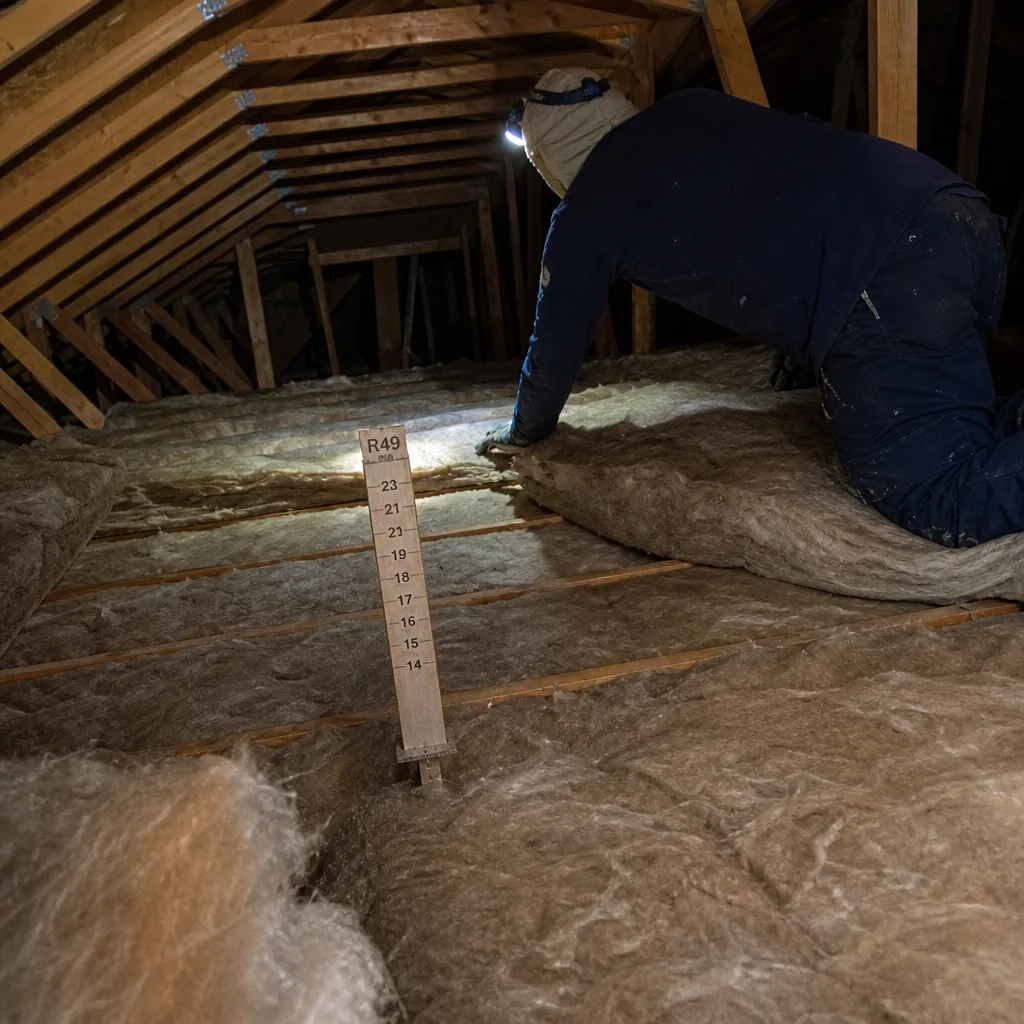
| R-49 upgrade (to current code depth) | $2,400 – $4,200 | What most older Whitney homes actually need |
| Mineral wool batts (Rockwool, Knauf) | $2,800 – $5,100 | Fire-resistant, handles temperature swings well |
| Spray foam, open-cell (Icynene, Demilec) | $3,200 – $6,800 | Air sealing built into the install |
| Spray foam, closed-cell | $4,500 – $9,200 | Highest performance, highest cost |
| Attic air sealing (added to insulation) | $350 – $850 | Cheapest energy win in the house |
| Old insulation removal | $1,100 – $2,900 | Required if material is contaminated or rodent-damaged |
| Radiant barrier installation | $1,200 – $2,700 | Big help in Whitney’s summer sun |
| Minor top-off / repair | $275 – $650 | Applying $40 off any repair over $200 |
The single biggest cost driver is whether old material has to come out. A clean attic where we’re blowing over existing fiberglass is a half-day job. An attic full of compressed, dust-saturated insulation from the 1990s, with rodent trails through it, turns into removal plus disposal plus reinstall, and that’s where you push toward the top of the range. Spray foam sits at the top because it seals and insulates in one pass, and because the material cost is simply higher than blown fiberglass.
If you want the material-by-material comparison with no prices attached, our Attic Insulation in Whitney page covers how each option behaves in a desert climate.
What Affects Attic Insulation Pricing in Whitney
Whitney is a specific place with specific problems. Las Vegas Valley heat, the age of the housing stock, and a few code realities all show up on the invoice.
- Attic square footage and current R-value. An R-11 attic from a 1988 build needs far more material than a 2015 home already sitting at R-38. We measure the actual depth and coverage area, not the floorplan square footage, because attic footprints are smaller than living space.
- Summer heat load and sun exposure. Whitney attics routinely hit 140°F or more in July and August. That accelerates the breakdown of older fiberglass and means a thinner-than-code layer is doing almost nothing. Homes with west-facing roof planes take the worst of it.
- Attic access and tight spaces. Low-pitch roofs, knee-wall attics, and crowded mechanical chases slow the work down. A walkable attic prices lower than one where the technician is crawling over ductwork with a hose.
- Air sealing required alongside. Nevada’s energy code treats the attic as a system. Sealing can lights, top plates, and plumbing penetrations before we add insulation is the difference between an install that works and one that just fills space.
- Existing ductwork condition. Whitney homes with leaking or unsealed flex duct in the attic lose cold air before it reaches a room. We flag it, and where ducts sit under a planned insulation depth, they have to be handled first.
- Rodent or pest damage. Rodent activity in valley attics is common, and contaminated insulation has to come out rather than get buried. Cleanup and proofing add to the total, but skipping it is a waste of every dollar after.
One thing that does not affect price much here: the brand of material. Whether it’s Johns Manville or CertainTeed blown fiberglass, the per-bag difference is small. What varies is installation quality, which is what the Walt’s Insulation team focuses on.
How to Save on Attic Insulation
You can’t bargain your way to a lower price in a market like Whitney, but you can avoid paying twice.
- Ask for a free second opinion on any written estimate. We’ll look at any quote you’ve been handed. If it’s fair, we’ll say so. If it’s charging you for a full removal you don’t need, we’ll say that too.
- Combine air sealing with the insulation job. Doing them together costs far less than scheduling sealing as a separate visit later, and it’s the change that shows up on your summer power bill first.
- Skip removal when it isn’t required. Clean, dry, intact insulation can be blown over. Removal only makes sense when material is contaminated or rodent-damaged, and you shouldn’t be sold it otherwise.
- Take the standing offers. We knock $40 off any repair over $200, waive the trip charge inside our service county, and give a permanent 10% discount to seniors and veterans. None of those are seasonal.
- Ask about the power bill math. A Whitney attic at R-11 versus R-49 can swing cooling costs noticeably through June, July, and August. That payback period is honest math, and we’ll walk you through it.
Free estimates are how all of this starts. Call (866) 810-4177 and a live person picks up, day or night. No voicemail, no callback queue.
Spray Foam vs. Blown-In: Which Costs Less in Whitney Over Time?
Blown-in fiberglass or cellulose costs less upfront by a wide margin, roughly half to a third of a spray foam job. Spray foam usually wins on long-term performance because it seals as it insulates, which matters a great deal in a place where attic temperatures in August push past 140°F.
Here’s the practical split. If your Whitney attic had a proper vapor barrier installed and the ducts and penetrations are already sealed, blown-in Owens Corning or GreenFiber at R-49 is the sensible spend. If you’re dealing with an older home where the attic plane leaks air everywhere, open-cell Icynene or Demilec spray foam handles both problems at once and the extra cost is often recovered faster than homeowners expect. We’ll tell you which one your house actually needs, with numbers.
What Should a Whitney Attic Insulation Quote Include?
A real quote should list the target R-value, the material and brand, the measured square footage, whether removal is included, and whether air sealing is part of the scope. If any of those are missing, ask.
We hand over written estimates with line items, not a single lump sum. That’s partly so you can compare apples to apples and partly because the attic insulation service we run is built around no-surprise pricing. The Done Right Promise backs the workmanship for life. If something we installed fails, we make it right. That’s the whole guarantee, and it doesn’t expire.
One more local detail worth knowing: a technician who shows up without a background check and a uniform shouldn’t be in your attic. Ours are background-checked and uniformed on every visit, so you know who’s in the house before they climb the ladder.
FAQs – Attic Insulation Cost in Whitney
How much does attic insulation cost in Whitney, NV?
Most Whitney attic insulation jobs run $1,450 to $4,800, with a typical single-family home around $2,400 for blown-in material at code depth. Spray foam pushes higher, to roughly $3,200 to $9,200. Call (866) 810-4177 for an exact quote, and the estimate is free.
Is it cheaper to repair or replace attic insulation?
Repair is almost always cheaper when the existing material is clean and only thin, usually $275 to $650 for a spot fix or top-off. Replacement runs $1,100 to $2,900 when the material is compressed, wet, or rodent-contaminated, and at that point repair money is wasted. We’ll tell you which side you’re on after a look.
What R-value should attic insulation be in Whitney?
R-49 is the target for this climate, and most older Whitney homes sit somewhere between R-11 and R-19, meaning they’re due for an upgrade. Getting to R-49 typically costs $2,400 to $4,200 for blown-in. Call us and we’ll measure your actual depth before quoting.
Do I need to remove old insulation before adding new?
No, if it’s dry, intact, and free of pest damage. Removal is only required when material is contaminated or has been compressed to the point of doing nothing, and that adds $1,100 to $2,900 to the job. We won’t sell removal you don’t need.
Can you come out today for an estimate?
Same-day estimates are often possible, and a live person answers our phones around the clock. The trip charge is waived inside our service county, there’s a free second opinion on any written estimate you’ve received, and seniors and veterans get a permanent 10% discount. Call (866) 810-4177 to get on the schedule.
Getting Started in Whitney
Attic insulation pricing in Whitney comes down to a few honest numbers: square footage, existing material condition, and whether air sealing is on the table. Most homeowners walk away knowing exactly what they’ll spend before anyone touches the attic, because we quote line by line and stand behind the work with the Done Right Promise.
Our technicians have up to 26 years of experience with everything from basic blown-in fiberglass to full spray foam systems using Icynene, Rockwool, Knauf, and Owens Corning materials. The one thing to distrust is a vague number over the phone. Call (866) 810-4177 for a free estimate and we’ll put real figures in front of you.
Pricing reflects the Whitney market as of 2026. Walt’s Insulation Whitney offers free estimates – call (866) 810-4177.
Written by the team at Walt’s Insulation.
What Our Customers Say
"The house had rats in the attic insulation and a smell we could not place. Walt's crew pulled all of it, sealed the gaps where they were getting in, sanitized, and put in new blown-in. He sent photos of the sealed openings so I could see it done."
- Rosa Delgado"Walt came out himself, stuck his head in the attic, and told me I had about four inches where I needed fourteen. No sales pitch, just the number and what it would cost to fix it. Crew was here two days later."
- Carl Meadows"Spray foam in the garage ceiling under the bonus room. That room used to be unusable in summer. Walt talked me out of foaming the whole attic because it did not need it, which saved me a couple thousand and I trust him more for it."
- Bud Larkin