
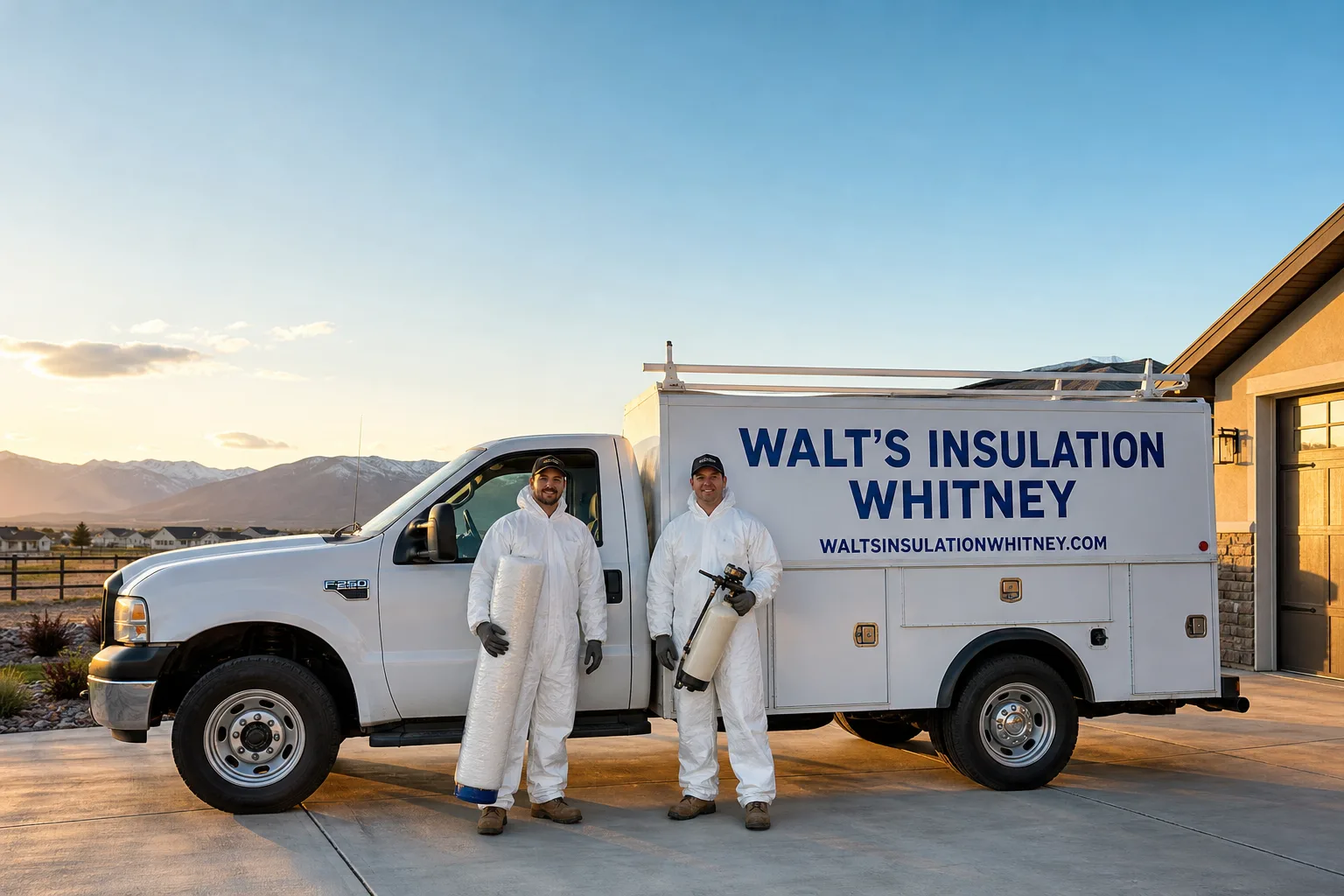
Trusted Blown-In Insulation for Whitney Homeowners
If your Whitney home feels like it can’t hold cool air through a July afternoon, the attic is usually where the answer lives. Blown-in insulation fills the gaps, corners, and odd cavities that batts miss, and it’s one of the fastest ways to cut a summer power bill in the Las Vegas Valley. Our technicians have up to 26 years of experience, and we bring that to every Whitney attic we open. We answer the phone live, 24 hours a day, and we can often get out same day for an estimate. Call (866) 810-4177 and let’s look at what your attic is doing.
What Our Blown-In Insulation Service Includes
Blown-in work isn’t one product. It’s a set of decisions about what goes in, how deep it goes, and whether the space is ready for it. Here’s what we actually do under this service.
Blown-In Cellulose
Cellulose is recycled paper fiber treated for fire resistance, and it’s the workhorse for attics that need depth fast. It settles tightly around joists, wiring, and recessed fixtures where fiberglass batts leave voids, which is why we lean on it for older Whitney homes with a lot of irregular framing. GreenFiber is our go-to cellulose line, and we blow it to the depth your home needs rather than a one-size number pulled off a chart. If your attic currently has bare joists or a thin layer of old material, this is usually the first option we price.
Blown-In Fiberglass
Fiberglass is the choice when you want a product that won’t settle much over time and holds its R-value predictably. It’s lighter, resists moisture better in some setups, and works well in attics that get inspected often or house mechanical equipment. We use Knauf and CertainTeed fiberglass depending on the space and the target R-value. In Whitney’s dry heat, choosing between cellulose and fiberglass comes down to your framing, your existing material, and how you use the attic.
Dense-Pack Wall Insulation
Dense-pack is blown-in insulation packed into finished wall cavities through small holes, and it’s how you insulate walls without tearing the house apart. We use it on exterior walls, knee walls, and the sloped ceiling planes common in Whitney’s older ranch-style homes. Dense-pack needs to be installed at the right density to actually perform, and doing it wrong shows up as sagging, voids, and cold spots within a couple of seasons. Our technicians set density by the material and cavity, not by feel.
Blown-In Top-Up
A top-up adds insulation on top of what’s already there when your attic has some coverage but not enough. Most Whitney attics we inspect are sitting somewhere between R-11 and R-19 when the desert climate calls for considerably more. Topping up is far cheaper than a full removal and gets you most of the benefit. We measure existing depth and type first, then tell you honestly whether a top-up is worth it or whether removal makes more sense. If you want the full picture on attic work, our home insulation services page covers the wider range.
Brands We Service for Blown-In Insulation
Knauf fiberglass is one of the materials we install most, and we know how it behaves when it’s blown into a tight attic with limited headroom. CertainTeed is the other fiberglass line we reach for, especially when a homeowner wants a product with strong moisture performance. With Rockwool, we use it where mineral wool’s density and fire resistance matter more than cost per square foot. Icynene comes into play on projects where a blown product and a spray foam approach need to work together on the same house.
The brand matters less than the depth and the prep work, but it does matter. A product installed at the wrong density or over a dirty, unsealed attic floor won’t perform no matter whose name is on the bag. We install blown-in insulation from manufacturers you’d recognize, including GreenFiber, Knauf, CertainTeed, and Rockwool, and we’ll tell you which one fits your Whitney attic and why. Whether you have one of those brands already up there or any other make, we can help.
Signs You Need Blown-In Insulation Right Now
Insulation doesn’t fail loudly. It thins out, settles, and gets crushed, and you notice it in your power bill before you notice it anywhere else. Here’s what we look for.
- Your summer power bill jumped and stayed up. When the AC runs longer each year without a real reason like a failing unit or a rate hike, the attic is usually the cause. In Whitney, we regularly see attics that have lost half their effective R-value to settling and compression.
- The attic floor has visible bare spots. If you can see the tops of the joists through the insulation, you don’t have enough. Blown-in settles over time and can get pushed aside by HVAC work, leaving gaps that let heat pour in all afternoon.
- Rooms over the garage are always hotter. That’s a classic sign the coverage over a different ceiling plane wasn’t handled correctly. Attics over garages and additions often need blown-in work done separately from the main attic because the depth and framing are different.
- You can feel warm air near the ceiling or around light fixtures. Insulation can’t fix an air leak by itself, but a thin layer makes the leak much worse. We check for air gaps before we blow anything in, since insulation over a channel of hot air does very little.
- You’ve had recent rodent or pest activity in the attic. Contaminated or disturbed insulation has to come out before new material goes in. Our blown-in insulation in Whitney service includes removal and replacement when that’s the honest call.
Our Blown-In Insulation Process – Step by Step
Here’s the sequence we follow on every Whitney job, because the prep work is what makes the insulation actually perform.
- 1
Attic inspection and measurement. We get up there, measure existing depth, identify the material type, and check for moisture, pests, and air gaps. We also look at the roof deck and ventilation so we’re not adding insulation to a space with a problem that has to be solved first. You get a written picture of what we found.
- 2
Air sealing before insulation. We seal gaps around recessed lights, top plates, wiring penetrations, and the attic hatch. Blown-in insulation on top of an unsealed ceiling is like a blanket over an open window. This step often delivers more savings than the insulation itself, and we don’t skip it.
- 3
Removal of compromised material when needed. If the existing insulation is contaminated, soaked, or too thin to be a base layer, we remove it and dispose of it properly. Old material that’s fine stays where it is and gets topped up.
- 4
Blowing to the target depth. We set the machine, then blow to a marked depth with a ruler in place, checking as we go rather than eyeballing. Depth markers every few feet keep the layer even, which is where a lot of installations fail.
- 5
Final walk-through and documentation. We show you the finished depth, explain what was sealed, and leave you with the R-value we hit. Every job is backed by the Done Right Promise. If something isn’t right, we come back and make it right.
How Much Does Blown-In Insulation Cost in Whitney?
A typical blown-in attic top-up in Whitney runs $1,200 – $2,600 depending on square footage, existing depth, and how much prep the attic needs. A full removal and replacement usually lands in the $2,400 – $4,800 range, and dense-pack wall insulation typically runs $2 – $4 per square foot of wall area. Those ranges reflect what we see across Whitney and the surrounding valley, not a national template.
| Service | Typical Whitney Range |
|---|---|
| Attic top-up (blown-in cellulose or fiberglass) | $1,200 – $2,600 |
| Full removal and replacement | $2,400 – $4,800 |
| Dense-pack wall insulation | $2 – $4 per sq ft of wall |
| Air sealing add-on | $300 – $800 |
What drives the number is attic size, how much old material has to come out, how accessible the space is, and whether air sealing is part of the job. The most common way homeowners overpay is paying for depth they didn’t need or skipping the air sealing that would have made the new insulation work harder. Every estimate we write is upfront and itemized, and if you have another written estimate you’re comparing, we’ll give you a free second opinion on it. The 10% senior and veteran discount applies permanently, and there’s no trip charge inside our service county.
Blown-In Insulation Near Whitney – Our Service Area
We serve Whitney and the neighborhoods around it, including Sunrise Manor, Paradise, Winchester, and Enterprise. Henderson, Spring Valley, North Las Vegas, and Las Vegas are all on our regular schedule, and we get out to Boulder City and Sandy Valley too. Homes closer in usually get same-day or next-day estimates, and outlying areas generally see us within a couple of days. If you’re in Sunrise Manor, our blown-in insulation in Sunrise Manor page has more on the older homes there, and blown-in insulation in Paradise covers the mid-century construction we see in that part of the valley. Just call and we’ll tell you exactly when we can be there.
Serving Whitney, NV – Our Local Coverage Area
We serve Whitney and nearby communities. Use the map below to see the area we cover. If you’re nearby, we can almost certainly help.
Frequently Asked Questions – Blown-In Insulation in Whitney
Blown-in insulation is loose fiber, either cellulose or fiberglass, that gets machine-blown into an attic or wall cavity to form an even layer. It fills gaps, corners, and around obstructions better than batts, which is why it’s the standard for attic work in the Las Vegas Valley. Whitney’s dry climate and intense afternoon sun make consistent coverage the priority. We can tell you in a short attic visit whether blown-in is the right fit for your house.
Most Whitney attic jobs take four to eight hours, and wall dense-pack work adds a few hours on top of that. A simple top-up on a modest attic can be done in half a day. We give you a realistic window when we schedule, not a vague “sometime today,” and we call ahead if anything changes.
Most homeowners here spend between $1,200 and $4,800 depending on whether it’s a top-up, a full replacement, or wall work. Full removal and replacement runs higher than a top-up because of the labor and disposal. We give free, upfront estimates with line items, so you know what each piece costs before you commit. Call (866) 810-4177 for an exact quote, estimates are free.
Yes. We install Knauf and CertainTeed fiberglass regularly, along with GreenFiber cellulose and Rockwool mineral wool. Each material performs differently in Whitney’s heat and dry air, and we’ll recommend the one that fits your attic and budget. If you already have one of these brands up there, we can top it up or remove and replace it.
Often yes. We answer the phone live 24 hours a day, and we keep same-day slots open for Whitney calls. Estimates are usually the fastest thing we can do same day, with the actual install scheduled as soon as we can get a crew out. Call and we’ll tell you what’s available today.
Every job is backed by our Done Right Promise, a lifetime workmanship guarantee. If the work isn’t right, we come back and fix it without a runaround, and that’s not a limited window that expires. Manufacturers’ product coverage applies on top of that for the material itself. We’ll go over both in writing before you sign anything.
Clear attic access and move vehicles so we can get equipment in and out. If you have storage in the attic, move it to the center out of the work area, and secure any pets. That’s usually all we need. We handle containment and cleanup, so you’re not left vacuuming insulation dust off your floors afterward.
Schedule Your Blown-In Insulation Service in Whitney Today
If your attic is thin, settled, or just not doing its job, call Walt’s Insulation Whitney at (866) 810-4177. We answer live around the clock, give upfront pricing, and stand behind every job with the Done Right Promise. Estimates are free and there’s no obligation, and the 10% senior and veteran discount is always available. Let’s get your Whitney home holding its cool again.
Written by the team at Walt’s Insulation Whitney.